

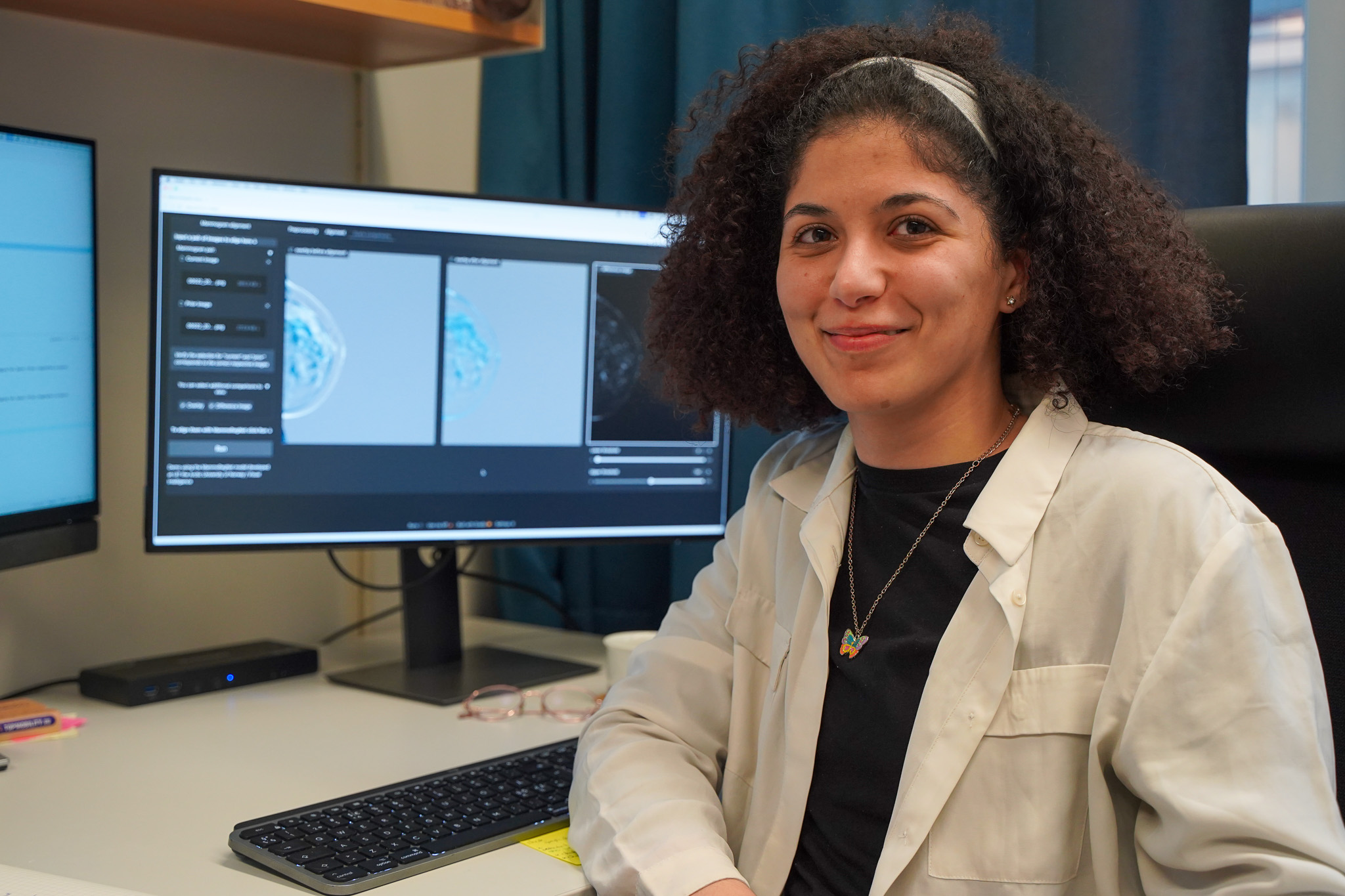
Cheyma Azzouz is a Master Student at UiT's Physics program.
Cheyma Azzouz, a Master Student at UiT's Physics program, developed a graphical user interface for aligning mammography images as part of an [AI]² internship. This can help doctors identify and track subtle tissue changes linked to breast cancer risk.
Cheyma Azzouz, a Master Student at UiT's Physics program, developed a graphical user interface for aligning mammography images as part of an [AI]² internship. This can help doctors identify and track subtle tissue changes linked to breast cancer risk.
By Petter Bjørklund, Communications Officer at Arctic Institute for AI in Science and Innovation
Radiologists spend significant time identifying and tracking subtle changes that could be linked to breast cancer. This is often done by aligning and comparing a patient's mammograms taken at different points in time.
This is by no means an easy task, says Cheyma Azzouz, Master Student at UiT's physics program.
"The breast's position, compression and deformation often differ from screening to screening. This makes the comparison less effective, which makes this task challenging," Azzouz explains.
To combat this, she has developed a graphical user interface for aligning mammography images.
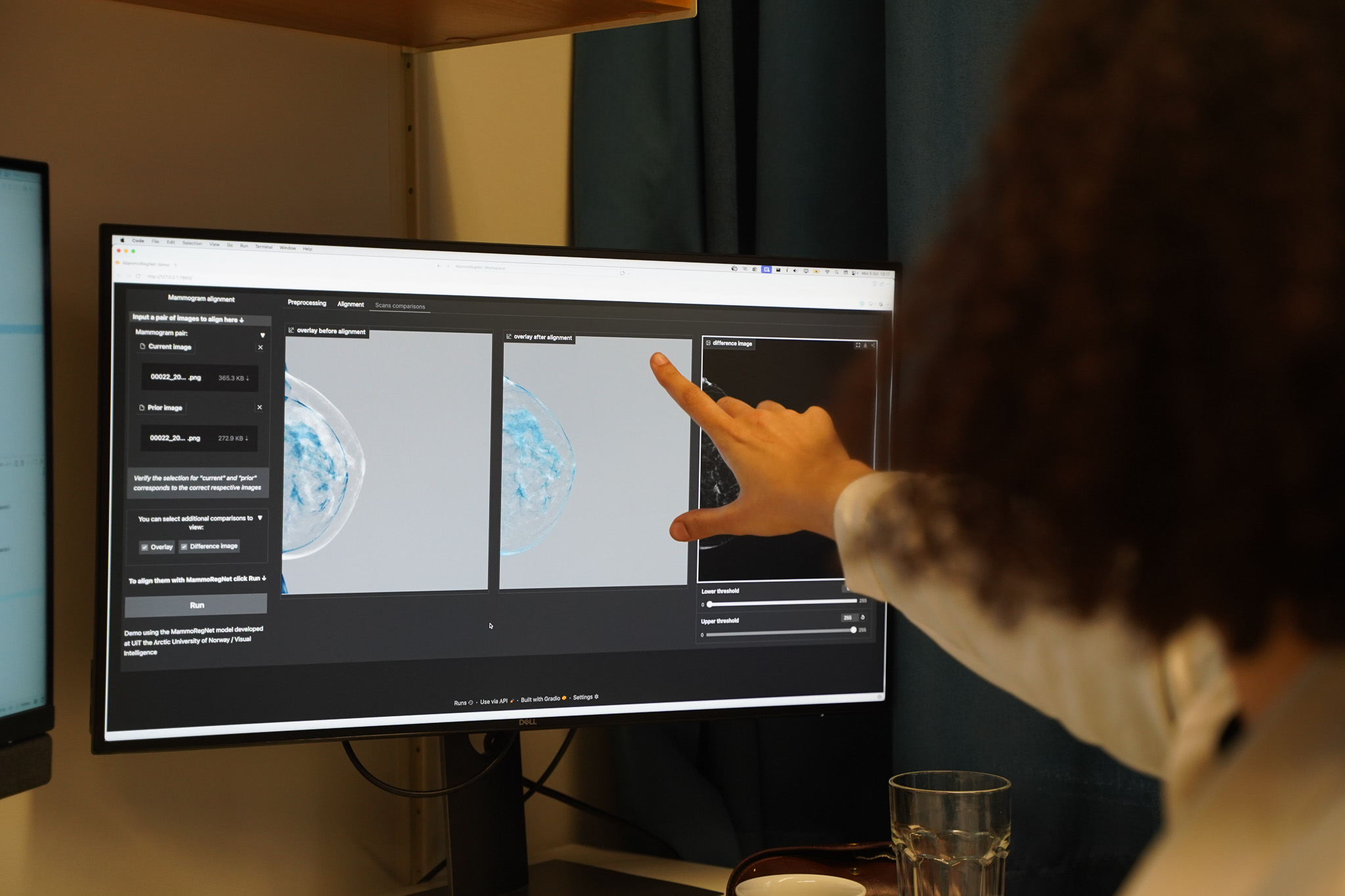
This was done by adapting MammoRegNet, an AI model that takes two mammograms obtained from different screenings and deforms the older scan to be accurately aligned with the latest one.
She says it has potential as a useful tool for doctors.
"The user interface gives this model a good frame and platform for doctors to apply the model to their scans. It is well adapted to the specificities of mammogram data, thought out to let them know what every step is doing and give clear visualisations and comparisons", she says.
The interface is ready to present to clinicians in order for them to try it and give feedback.
Azzouz developed the software as part of an [AI]² internship.
Azzouz says it is very motivating to participate in a project that is accessible to her own level of experience.
"I'm really grateful to have gotten the opportunity to try it out for myself and build a first experience on it, particularly while already contributing to active research having impact."
Kristoffer Wickstrøm, associate professor at UiT's Machine Learning group, says this type of software is the first step towards making a tool that is useful for radiologists.
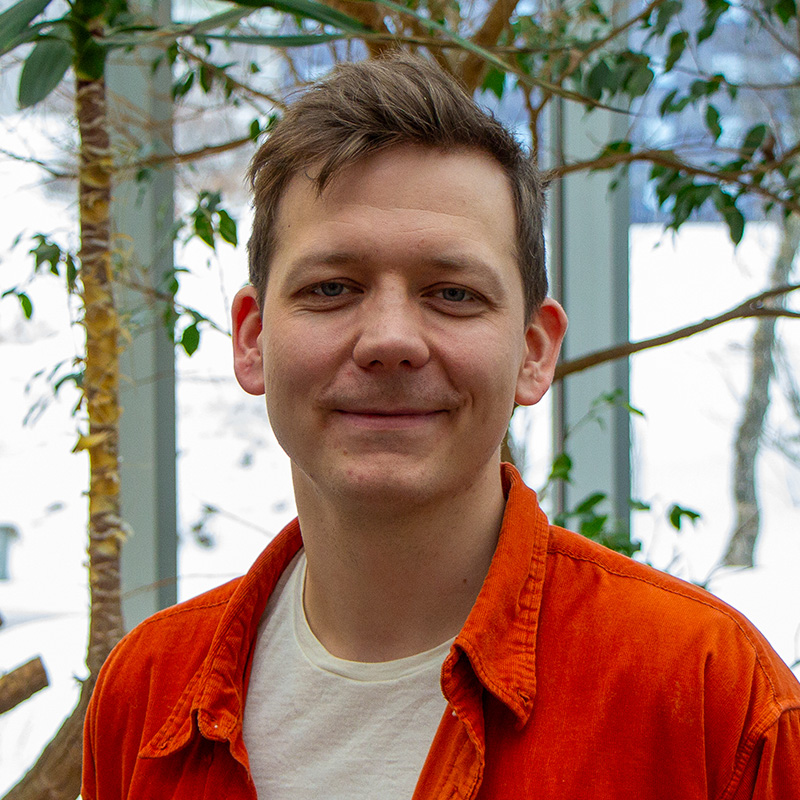
"Research software can only get you so far. To make algorithms useful they need to be further developed so they are intuitive, easy to use, and can be integrated into the clinical workflow. This is not an easy task and requires close collaboration with user partners," says Wickstrøm.
He says Azzouz' software provide a starting point for making AI algorithms available for radiologists.
"It has also given us valuable experience for creating similar software for other user partners in Visual Intelligence," he adds.
The GUI provides a user-friendly interface for the AI algorithm MammoRegNet that is developed by Solveig Thrun, PhD Fellow at SFI Visual Intelligence.
"Changes in the breasts can be an early sign of cancer development. It could also provide valuable information about the best possible treatment for patients, " says Wickstrøm.
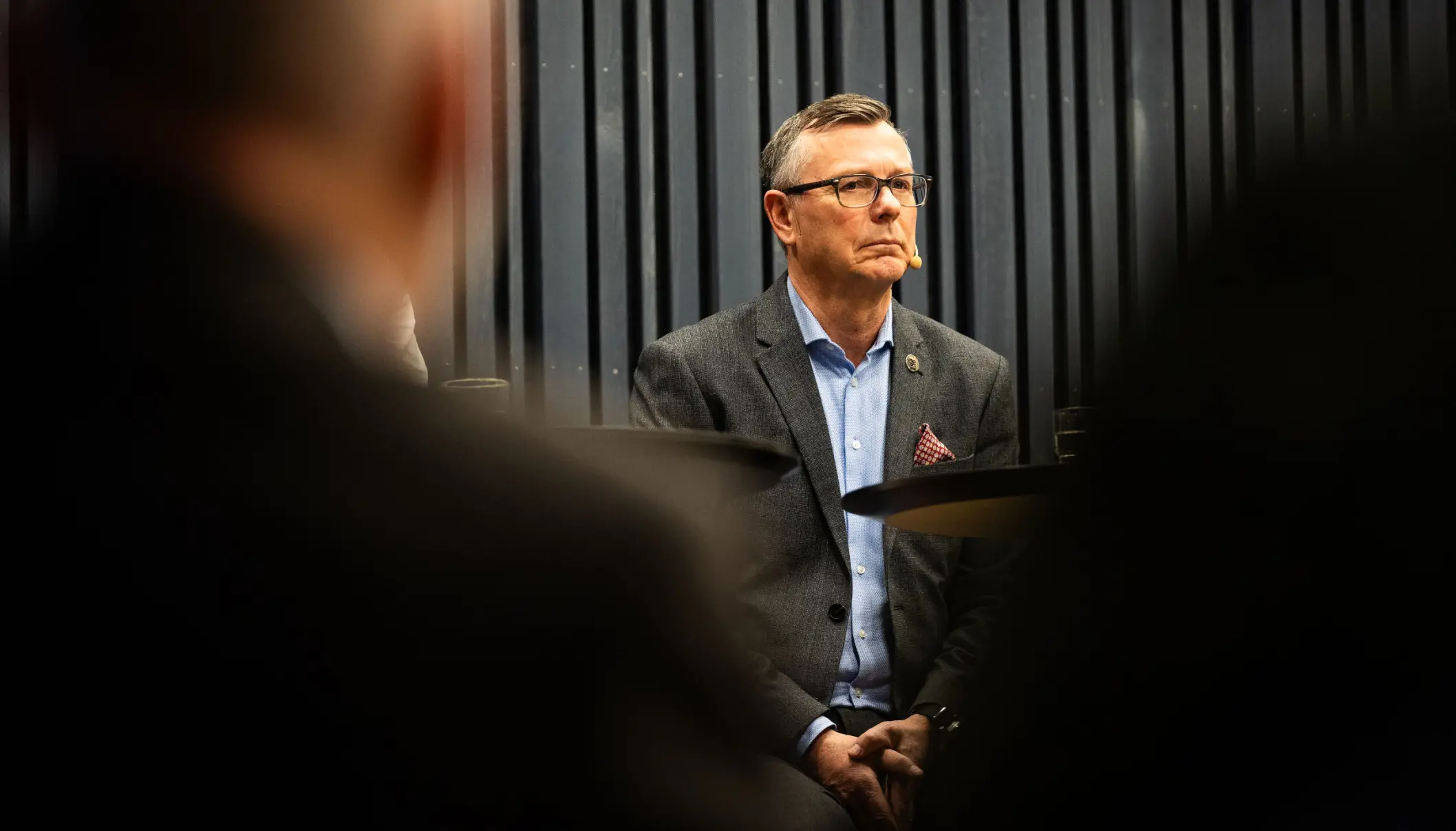
Norge må ta lederskap i ansvarlig KI-utvikling — ikke ved å stå på bremsen, men ved å bygge kompetansen som gjør oss i stand til å styre (Norwegian opinion piece in Khrono.no).
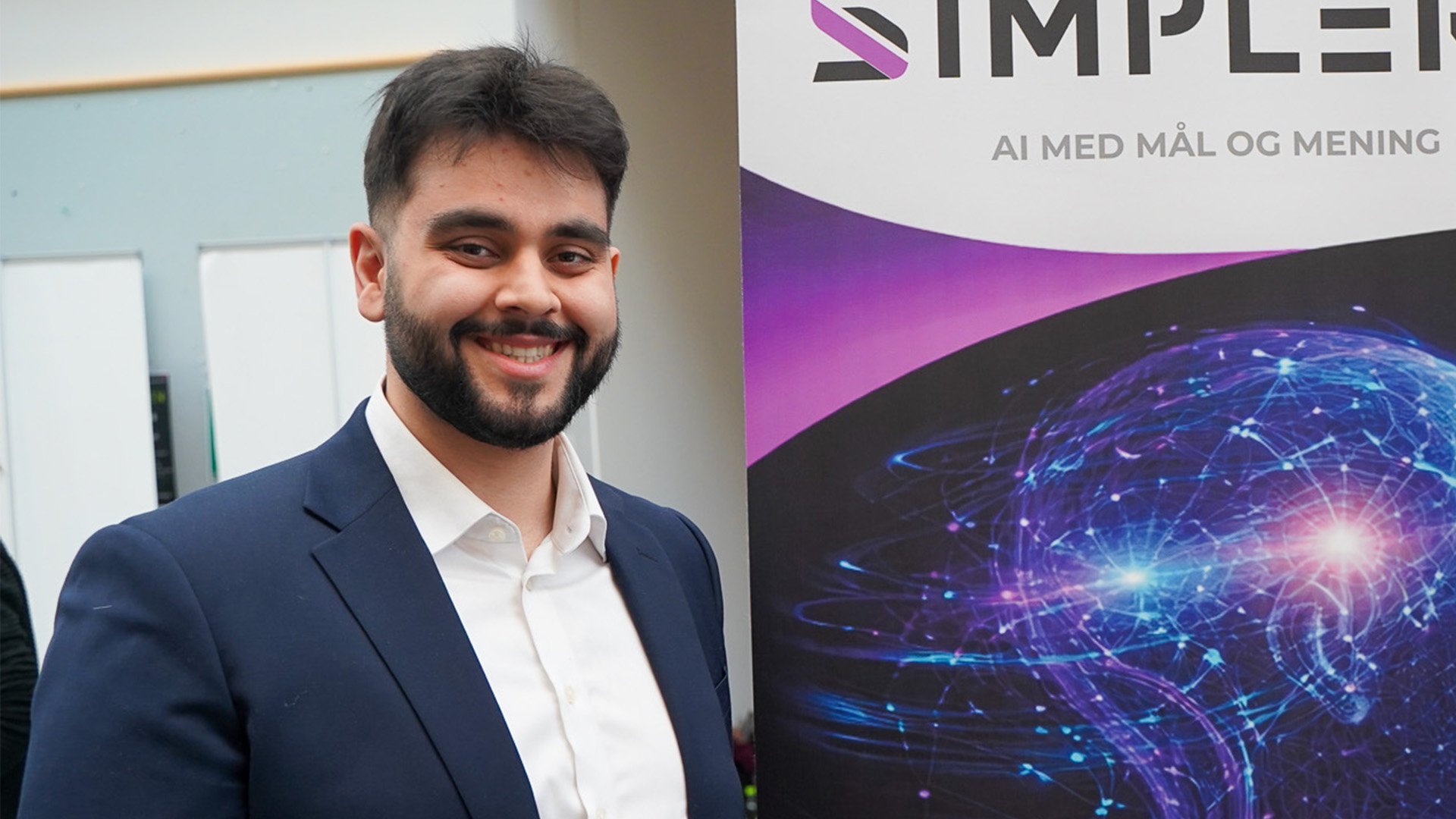
Kian Sartipzadeh, a Master Student at UiT's AI study program, talks about his experiences as a summer intern at the Arctic Institute for AI. Together with UiT's finance department, he developed an AI system to assist the finance staff with correcting invalid invoices.

The areas above the Arctic Circle are facing sweeping changes and pressure. How can artificial intelligence (AI) contribute to more resilient communities in the north?
.png)
Congratulations to Centre Director Robert Jenssen, who was appointed as a new fellow at the International Associaton for Pattern Recognition (IAPR).
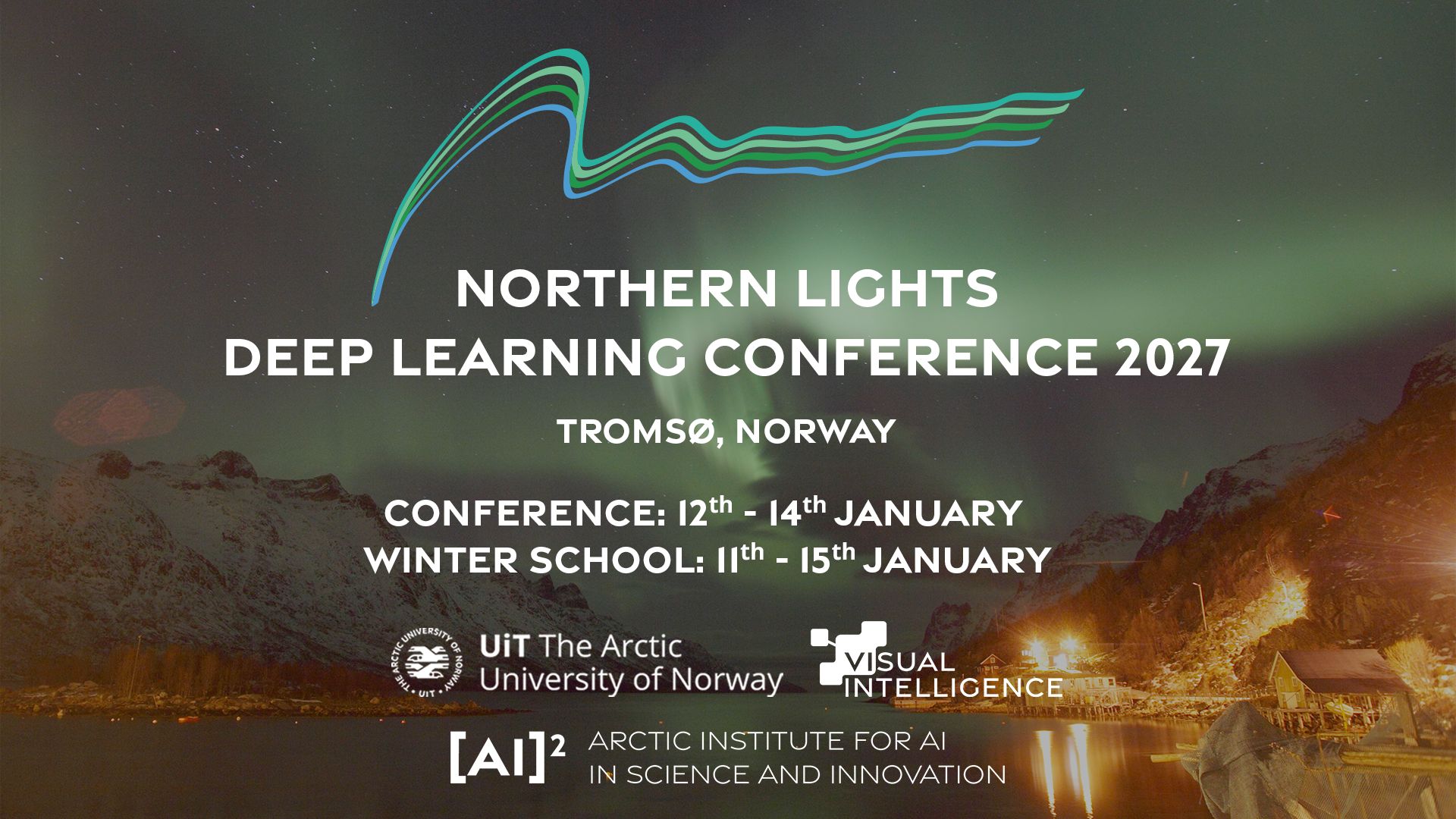
Arctic Institute for AI in Science Innovation is proud to be a co-organizer of the Northern Lights Deep Learning Conference 2027.
.jpg)
Områdene over polarsirkelen står overfor omfattende endringer og press. Hvordan kan kunstig intelligens bidra til mer motstandsdyktige samfunn i nord? Dette ble diskutert under Arendalsuka der tema var KI sin rolle og betydning for Arktis og nordområdene (News article at uit.no)
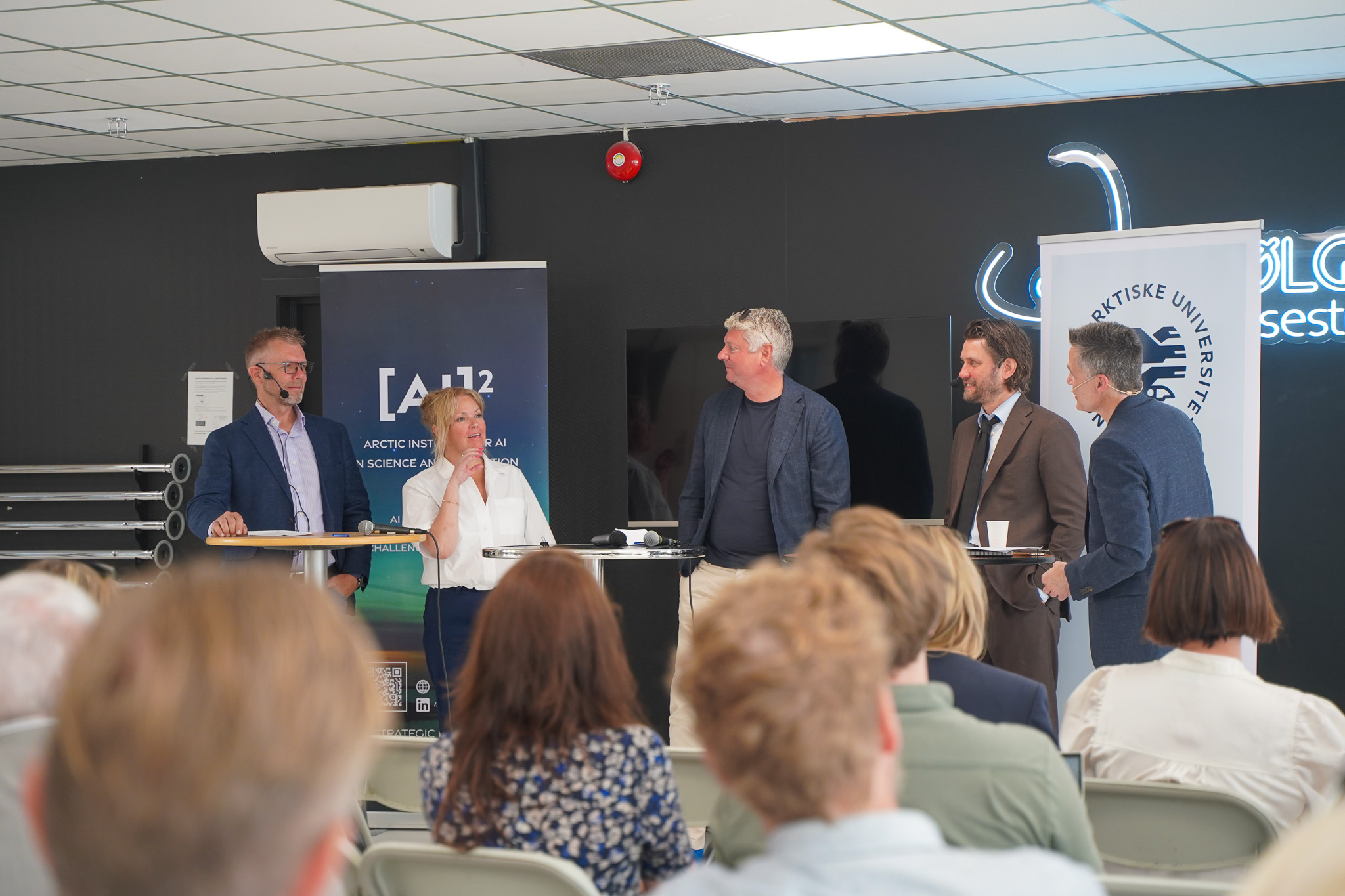
The Arctic Institute for AI gathered representatives from industry and Norwegian politics to discuss how AI can be used to handle pressure and changes in the Arctic region